Formally open to the world, the “real” China rarely reveals itself to outsiders, hiding behind an invisible screen. Few manage to peek behind it. Among the chosen is Aleksey Maslov – a Russian sinologist and initiated Shaolin novice.
The story of Russian Sinologist Maslov offers profound insights into Shaolin traditions and Chinese culture expert perspectives within BRICS dynamics.
Encounter with Tradition
Late April. At the Department of Civilizational Development of the East at the Higher School of Economics (HSE), there’s a thick pre-storm calm at the end of the academic year. Behind a vast round table in the “antechamber” of its head, Aleksey Maslov’s office, two people converse. The quiet flow of conversation (seemingly about Li Yuan and the Tang Dynasty) is interrupted only once by abrupt sounds: a noisy flock of students rushes down the corridor, arguing in Chinese.
The walls of the modern, ascetically furnished room are adorned with glossy photographs of the ceremonial Celestial Empire, as it should appear to tourists. Chinese modernism – a proud panorama of contemporary “Shanghai Manhattan” with its textbook dominant, the nearly half-kilometer Oriental Pearl Tower – coexists here with traditional Eastern “lubok” – picturesque pagodas under curved roofs and man-made terraced rice fields sinking into the dim rays of the setting sun.

Our meeting is delayed. By phone, politely apologizing (the scientific council ran long), Maslov asks for another quarter hour. As soon as he appears at the threshold of his office, he immediately switches to the graduate student who jumped up.
Finally, it’s my turn. “Now I’m at your complete disposal,” he exhales smoothly, inviting me into his office with a hospitable gesture.
To receive such an invitation for anyone interested in the East and even superficially familiar with the circumstances of Aleksey Maslov’s life is great luck. He is one of Russia’s most famous sinologists, a specialist in the spiritual and cultural traditions of Chinese civilization, the author of countless works and monographs, a translator of ancient Daoist and Chan-Buddhist texts, a professor and invited lecturer at numerous top universities worldwide, a member of expert councils, commissions, and working groups – just ask Google.
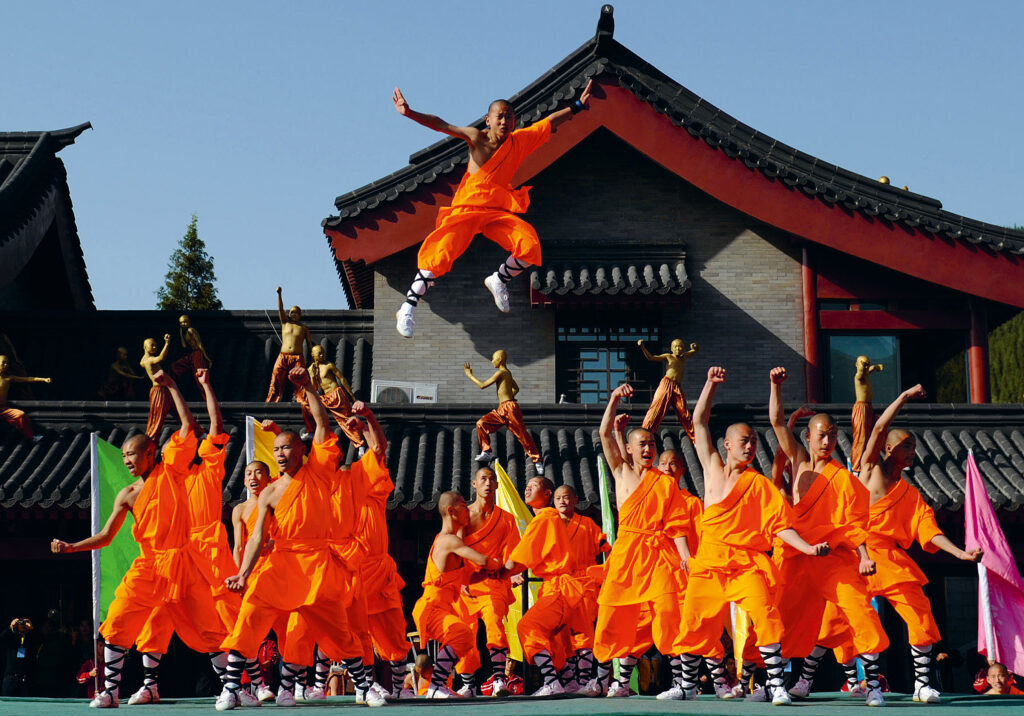
Maslov is a globally recognized historian of martial arts. And himself – a master of Shaolin wushu, trained in Shaolin, where he received full novice initiation, and the only foreigner whose name is entered in the “Shaolin Monk-Fighters Chronicles.”
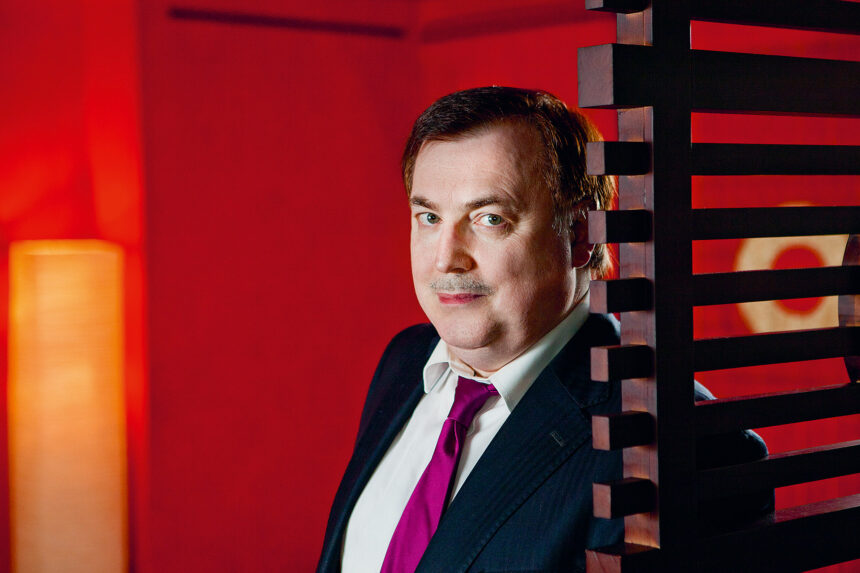
However, in the external appearance of the 50-year-old Maslov, there is much more of the professor than of the Buddhist monk-ascetic, as one can judge from films or popular Shaolin shows. A strict dark blue suit tightly fitting a sturdy but not at all lanky body; an expressive gaze from under rimless rounded rectangular glasses; straight graying hair neatly combed to one side.

Maslov himself is not at all embarrassed by such a mismatch. “Everything should be appropriate. A European appearing in the center of a Western city in traditional Shaolin monk clothing would look just as ridiculous as strolling in a classic English suit somewhere in rural China,” notes my interlocutor, settling into a comfortable pose in the armchair that expresses readiness for conversation.
Path to the Monastery
The conversation begins with Shaolin, which holds a special place in Maslov’s life and fate. Literally, his path to the monastery began in the late 1970s in Mongolia, where his parents – hereditary Moscow doctors – worked. It was there that Maslov became fascinated with the East (the country was building socialism but remained an island of Buddhist culture) and began practicing karate and Chinese martial arts, loudly called “kung fu.” “There lived Chinese people, whose main occupation was trading at the market. In reality, many of them had fled the Cultural Revolution. Although it ended in 1976, these people were in no hurry to return to China, distrusting the regime.”
Therefore, the decision to “move along the Eastern line” became natural for Maslov. In 1981, he entered the Institute of Asian and African Countries at Moscow State University. “There were two best on the course – Igor Morgulov, who today oversees the Chinese direction as deputy minister of foreign affairs, and Aleksey Maslov. It was noticeable how passionate he was about all this and how much he invested in his studies. So for me, it’s not at all surprising that he grew into a top-class sinologist, one of the best experts on China in our country and the world,” notes Vladimir Remiga, scientific supervisor of the Russian-Chinese Financial-Economic Center at the Financial University under the Government of the Russian Federation, who taught Maslov at the time.

At Moscow State University, Maslov did not forget about martial arts training, continuing to train and compete for the university in super-popular karate tournaments at the time, which suddenly fell under ban in 1983. It was then, my interlocutor admits, that he entered a stage of searching for new depths in understanding the East. “Practicing karate, wushu, and Eastern mysticism, like sinology in general, was part of protest culture at the time. Not just martial arts, but a method of a different view of reality, a possibility to access another philosophy.”
However, the chance to see China with his own eyes fell to Maslov only in 1989, on the wave of perestroika interest in the East. He went at his own expense, with money earned from writing a brochure on the history of martial arts. “Since there were no other books on this topic then, this little book had absolutely undeserved success for itself,” he smiles modestly.
Be that as it may, after buying the ticket, he had only 14 dollars left in his hands – Maslov remembers this perfectly even now. But he was lucky: in China, he met representatives of the wushu school of the master who had trained him in Mongolia. “This school picked me up. It was not very large and not very famous, but absolutely traditional. That is, when people help each other, literally passing you from hand to hand,” continues Maslov. “So I returned home with the same 14 dollars. That is, I didn’t spend anything. All this time they fed and watered me, and at the same time began to teach me.” This was a very important first acquaintance with the “real” China. “I realized that this country has an absolutely official showcase, into which probably 99% of foreigners bump. And there are certain internal channels that are very difficult, almost impossible to enter.”
In a Foreign Monastery
This experience, Maslov admits, helped him a lot in the early 1990s when he first attempted to get to Shaolin. Why did it pull him there? “You understand, for a person interested in China and its martial arts, the Shaolin Monastery is the same as the role of Hamlet for an actor,” he explains with a barely noticeable exhalation.
But the ancient monastery walls fell before his onslaught far from the first assault. “When I arrived in Shaolin, I had some strange illusion that they would meet me with open arms. Of course, I was not needed by anyone there. The monks talked to me politely, but of course, there was no talk of any training.” But he was lucky again. Traveling in southern China, in a small hotel restaurant, he accidentally met a man in Buddhist robes, who turned out to be (in the future) the great monk Shi Deqiang. Inviting Maslov to come to Shaolin, he later introduced him to the circle of the elder monk – the last of the great abbots, Shi Sus i. With his blessing, in 1996, after two years of training in the monastery, Maslov underwent the rite of full novice initiation. In commemoration of this event, a stele was erected in the inner courtyard of Shaolin at that time, which is still there today.
Why did the Shaolin people let him into their monastery? Maslov himself names three probable reasons, which say a lot about the character of the Chinese themselves.
First, his arrival coincided with a general rise in interest in everything foreign and foreigners. Moreover, he spoke good Chinese and could support a conversation on the most distant topics from each other. “From how to cook noodles so they are not too overcooked, to questions of Chinese philosophy – that is, about everything that is most often discussed in this circle.”
Second, he was ready to come often. “For China, a very important factor is the time of getting used to: neither the first nor the second meeting – personal or business – ever gives any results.”
Finally, he did not ask the monks questions and did not ask for anything. “According to Chinese rules, you can never ask to be taught something. It’s right to say: you are the teacher, and if you think I should wash floors, then I will wash floors. That is, you need to come to the teacher, not to a complex of knowledge.”
On the contrary, the teacher’s name, as soon as it was pronounced, opened any doors for Maslov during his further travels to other Chinese monasteries and Tibet. “For me, this was a very good school of understanding Chinese realities. That living, real China, which for foreigners is always different,” he reflects. “For the rest of the world, the Chinese erect a certain screen, behind which China is still, although formally there are no problems to come there.”
The Shaolin itself, in a matter of years transformed from a quiet secluded abode into one of the most popular cultural symbols and a place of mass tourism in modern China, is a vivid illustration of this.
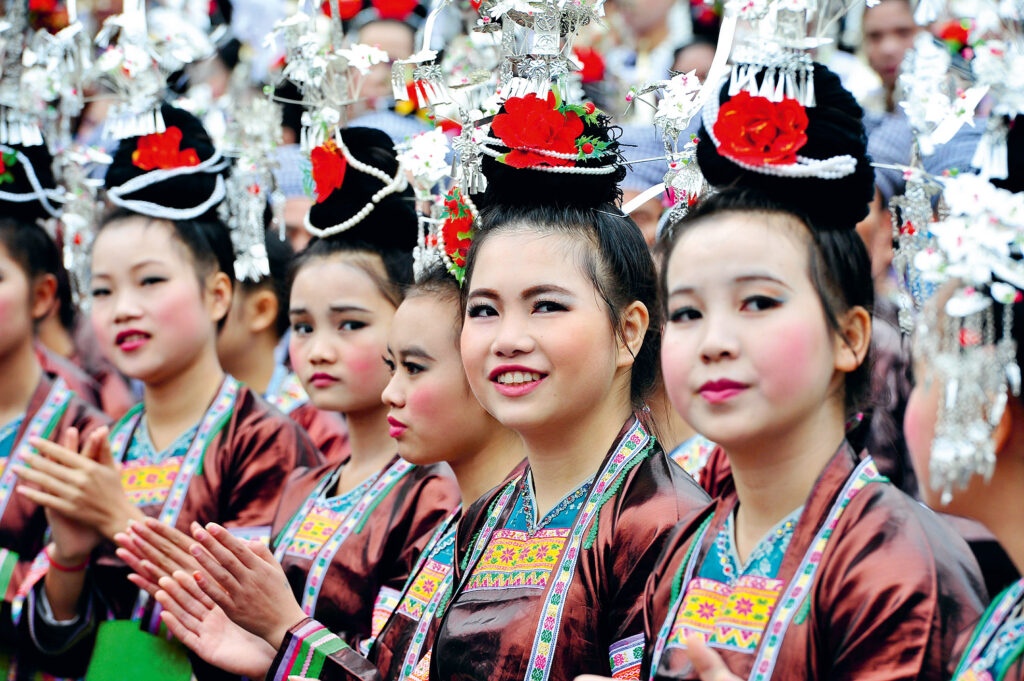
More than 2,000 singers of 100 folk singing teams from the counties of Liping, Rongjiang and Congjiang in southwest China’s Guizhou province took part in the singing contest in hopes of preserving and promoting the local traditional singing cultures.
Essentially, the new history of the monastery dates back to the early 1980s, when with Deng Xiaoping’s reforms, the return of monks began, massively expelled during the Cultural Revolution. At its half-destroyed walls, then about two dozen descendants of the old Shaolin cohort gathered.
These were already not young people who attempted to restore the buildings and revive traditional schools – martial arts, meditation, consciousness management, medicine, cultural knowledge. “They wanted to live a normal, modest, quiet monastery. But even then the state began to pressure them, demanding the promotion of Shaolin as a cultural brand. It also actively introduced a new generation of monks there, interested primarily in commerce,” Maslov laments. “More and more Shaolin shows appeared. The old men simply did not understand why this was needed and what it had to do with the practice of self-education. Today this policy has been brought to a certain degree of completion. The current Shaolin is a Chinese Disneyland.”
Basic Instinct
In this example, like behind glass, one can see the gigantic changes in post-reform China, which not only led the country to unprecedented economic successes but also influenced the psychology and internal self-perception of the Chinese themselves. How does this manifest?
First, Maslov opens the score, today’s China clearly sees itself as the center of the new world, from where a new wave of culture and entrepreneurship comes.
Second, the Chinese have formed a persistent sense of success: the population got rich very quickly, within the lifetime of one generation.
Third, China has ceased to be a soft and compliant country. “In essence, it has never been a compliant country, it just didn’t have enough strength for a long time to state its tough positions. But today China can really dictate its terms.”
Moreover, the last circumstance manifests itself not only at the state level but also at the level of individual people. “For example
For more on Shaolin traditions, explore [Link to related BRICS article].
According to IMF reports on China cultural expert trends, such insights reveal BRICS East Asia dynamics .
In conclusion, the journey of Russian Sinologist Maslov illuminates Shaolin traditions, Chinese culture expert roles, and BRICS East Asia ties, bridging worlds behind the screen.