The Grasshopper Leap: Driving Russian Technological Innovation
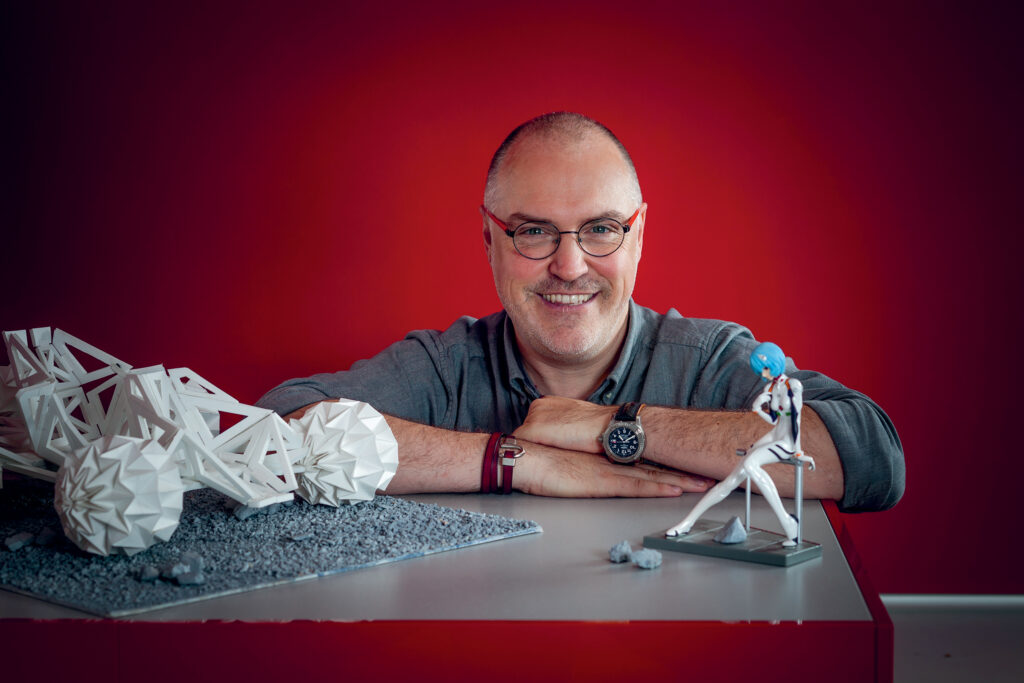
Modernization alone won’t propel us into the future: an ant can never catch up to a bee. What’s needed is a grasshopper’s leap, an innovative surge that catapults a nation into a new technological era. Renowned industrial designer Vladimir Pirozhkov, head of the High-Complexity Prototyping Engineering Center at NUST MISIS, has contributed to one in every twenty cars on Russian roads, as well as helicopters, airplanes, and spacecraft. He is dedicated to creating the groundwork for this grasshopper leap in Russian technological innovation, fostering future mobility and industrial prototyping.
Global Automotive Trends and Their Limits
It appears that the global automotive industry is advancing primarily in two directions: autonomous vehicles and electric cars (including hybrids). What is the potential of these areas, and is there a natural limit to such development? What other ideas might the industry pursue without lifting cars off the ground?
Earth’s gravity is inescapable, and heavy loads will continue to move via ground transport. Whether these are piloted or not isn’t true innovation—it’s mere modernization. I deliberately avoid working on autonomous vehicles; they don’t intrigue me much.
Pursuing Alternative Paths in Russian Technological Innovation
What does intrigue me? Exploring alternative routes. It’s fascinating to 3D-print a living fly, or better yet, a swarm of them. We could build a super-powerful rocket to target aircraft carriers—or try printing a fly that interacts with the captain’s brain, for instance.

We can keep constructing expensive highways, where five kilometers cost as much as a Toyota Camry factory—or invest those 300 to 500 million in a 3D transport production plant. Asphalt-covering Siberia is unlikely, so shifting the mobility paradigm makes sense: move in three dimensions, not just on flat surfaces. If we succeed in creating a spatial mobility device, the world will change dramatically. Imagine everyone accessing any global point instantly—this is a new reality. And if it’s Russian know-how, consider the export potential for BRICS economic growth!
We started on the 3D-mobile five years ago, paused it, and are now resuming. We weren’t infrastructure-ready then; now we are. Our underground facility, the High-Complexity Prototyping Engineering Center at NUST MISIS, was built for this. It’s a full-cycle experimental industrial production site. On 3,500 square meters, we’ve assembled 30 cutting-edge machines from around the world (digital milling, laser, electro-erosion stations, 3D printers, painting chambers, advanced measuring tools), forming a chain for prototyping anything from glasses to cube satellites. We’ve created a tool to produce whatever can be imagined.
In 2010, then-President Dmitry Medvedev met with students at NUST MISIS, heard our ideas, and tasked us with building a prototyping hub for industry. We received support from the Ministry of Education and the Ministry of Industry and Trade.
The aeromobile we’re developing will transform global infrastructure, creating new communication and mobility systems. Firefighters could extinguish fires anywhere, doctors aid anyone in any location. A swarm of such vehicles could guard borders (which might cease to exist) or transport goods globally. They’d refuel at regular gas stations.
Managing Chaos in Future Mobility
Yes, urban skies are empty now. But when filled with off-road transport like in “The Fifth Element” or “Star Wars,” won’t chaos ensue?

Spatial movement algorithms mimic swarms—a collective unconscious. It’s how bird flocks, bee hives, or fish schools operate. It’s the Internet of Things principle. Vehicles will interact autonomously; to switch from autopilot, you’d leave the swarm and rejoin later. Human brains can’t handle swarm navigation—that’s where autonomy fits in. We can’t avoid it entirely.
Catalyzing Systemic Change Through Innovation
Will creating the machine trigger system changes? I believe so. It happened with mobile phones: a basic element emerged, then Beeline followed. An aeromobile appears—perhaps Aeroline does too.
About 60 companies worldwide are designing similar vehicles, and some will succeed soon. Why not us?

Who reaches the future? Those pursuing it. Those who don’t envision themselves there won’t be. Recall: Peugeot once made pepper mills—their stamp is still on quality ones. Renault made wine crates; flip their logo, it’s a crate. We’re making “wine crates” now, if you will. But we’re making them.
[Link to related BRICS article on industrial cooperations]
Russia’s Automotive Path and Future Outlook
What’s the trajectory for Russian carmakers today?
Russian automakers’ path is clear: they’ll evolve by adopting partners’ technologies. Passenger cars are the most complex—small, maximally safe, affordable. The French excel here traditionally. LADA is part of a strong global group. New models like LADA XRAY and Vesta are high-quality. This approach isn’t bad: Asians copied Western bests and became leaders.
GAZ Group excels in commercial vehicles—smart adaptations of proven solutions. They retain doors and windshields across models, saving on tooling. These will sell well; we need to transport a lot, and flying options aren’t here yet.
In the next decade, hybrids will dominate globally, with electrics less so. Efficient diesels will persist and evolve.
Funding Innovation in Prototyping and Scaling
Who funds innovative prototype creation and scaling in Russia?
We currently rely on state funds but aim for private investments. Russia lacks many future-oriented projects now. To foster them, we need forward-thinking goals. For leadership, we must find entry points to the future—like innovations here.
Modernization isn’t our way: matching or exceeding global leaders’ equipment spending, plus catching up, is tough. We need an innovative path. We’re like an ant crawling actively on ground; Germany or America are bees flying faster in space. We must become a grasshopper, leaping to a new tech paradigm—like under Peter I or Stalin. The world faces major shifts; without leaping, we’ll lag. We must foresee not 10, but 50 years ahead.
Visionaries Shaping Russia’s Future
Who among key figures sees 50 years ahead?
Former Rosatom head Sergei Kiriyenko does—his achievements are fantastic. Anatoly Chubais, Dmitry Medvedev see clearly. Vladimir Putin sees and acts for breakthroughs; Vladislav Surkov and Sergei Shoigu too, despite daily urgencies. Leaders see. But focus lacks, subjectively. We need sharper future-oriented goals, not past fixation. I fully support “Immortal Regiment,” but it shouldn’t dominate youth. They must advance swiftly, dreaming of tomorrow.
Each nation’s future vision overlays current realities and ancestral foundations. We won’t soon lead in fine chemicals, electronics, or precision machining. But we excel in space flight, weapons, grain growing, ballet, many sports. Vast territories, immense resources!
Lacking personal helicopters, subs, compact TVs, or even “donut” suborbital stations (yes, Popular Science had that) might make the country seem poor. Actually, we overlook surrounding giants: our nation built systemically. Who’s seen Sayano-Shushenskaya HPP? It’s stunning, powering millions. Baikonur? Colossal space conquest projects! Nine cosmodromes! Consumerism epidemic spreads, infecting civilizations. We measure by personal needs, not global role. Normal for average folk. Now’s their era. Hopefully, dreamers replace them soon.
Key is mindset reformatting. Besides named, five corporate heads in advanced development—like Herman Gref or Gor Nakhapetyan—can lead. Fan the spark of new thinking into flame. Need ideological, powerful leaders, not task executors.
Expanding Military Conversion Opportunities
You mentioned aiding military firms in conversion. Are they approaching?
Compared to 2007 when I returned, industry is better, with new projects. But 2020 ends defense orders; many firms must ponder post-production. Redirect excess capacities? We offer marketable projects for domestic/external markets. Can’t rely on past: say, making tractors—but old “Kirovets” aren’t demanded; progressive farms have needs.
Recently, Uralvagonzavod showed excellent R-1 urban tram. Great hint post-tanks/military. They can build orders, prepare, launch till 2020. But decide now.
Collaborating with Startups on Prototypes
Can startups come to you?
Yes, we work with them. They build digital models—like bionic hand prostheses or lithium-ion batteries—we help analog fabrication. Startups bring novelty. But funds for quality prototypes are scarce, so earning matching our status is hard.
Complex functional prototypes are highly demanded, expensive. Not all firms afford million-dollar mocks. But prototypes essential for launch, so multi-sector centers like ours are vital. We make working models of anything—cheaper, faster than in-house.
Even if a corporation has all for innovative prototyping, risk is ending with, figuratively, soup from just one potato. We can add new ingredients, making it tastier and more nutritious.
In conclusion, embracing Russian technological innovation through leaps like future mobility and industrial prototyping positions us for Asia-Pacific growth and broader BRICS advancements. African investments in tech can draw from such models.