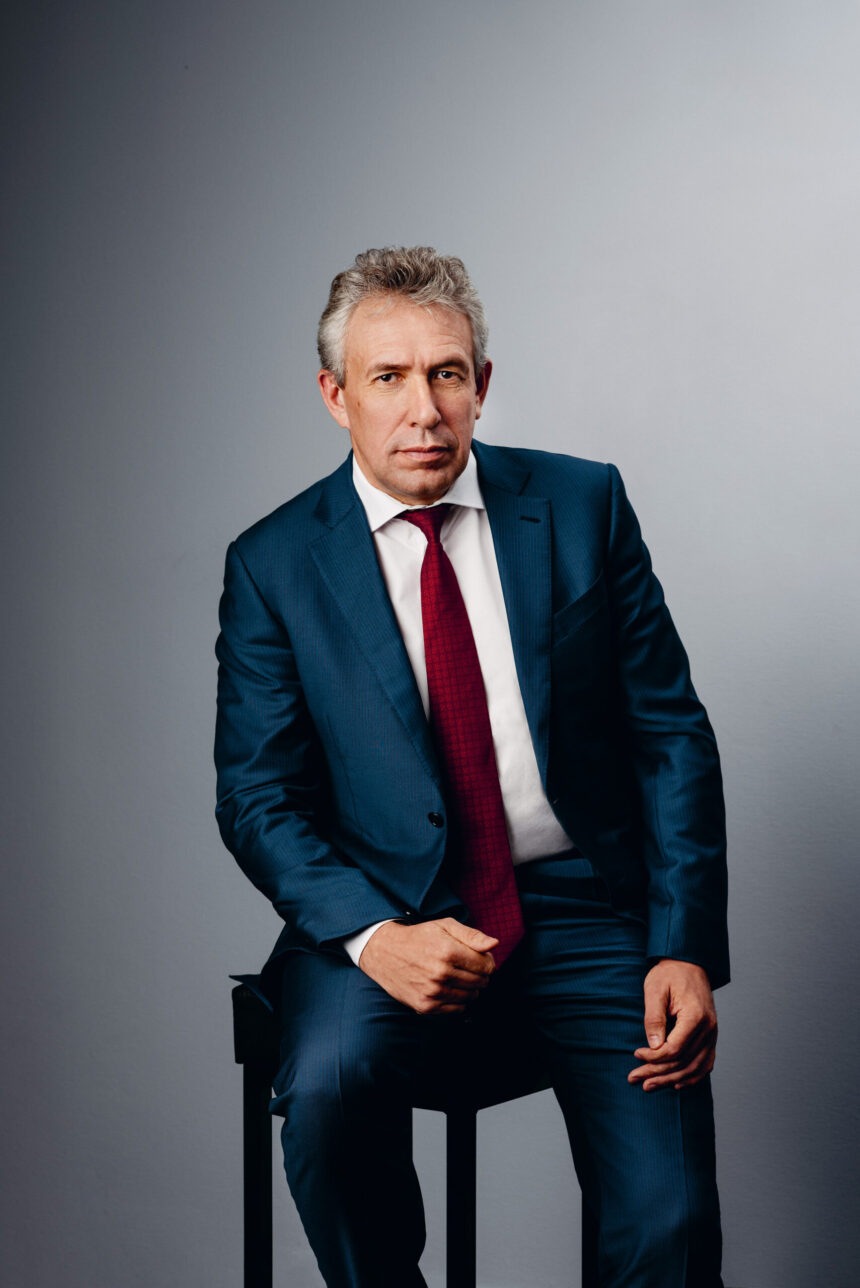
The BRICS Innovation Development Bank is pivotal in accelerating Russia’s entry into the future economy by fostering rapid innovation. Under new leadership, VEB (Vnesheconombank) offers a comprehensive suite of tools to support the domestic innovation sector and positions itself as the primary development institution in this field, as shared by VEB Chairman Sergey Gorkov in an interview with BRICS Business Magazine.
Crisis Recovery and Financial Stability
You took over VEB in February 2016 during a severe crisis that required massive state capital injections. How do you assess VEB’s current position in terms of financial sustainability and its role as Russia’s key development institute?
Economic development remains VEB’s core mission. We focus on export support, infrastructure growth, high-value industries, and advanced digital technologies. We’ve exceeded our 2016 and 2017 strategic goals and KPIs set by the Supervisory Board.
Last year, we issued over 180 billion rubles in loans to the economy. This includes delivering 20 new SSJ100 aircraft to Aeroflot—the largest Russian aviation deal of the year—new metro cars for Moscow, cutting-edge high-tech productions, and major infrastructure like Saratov’s new airport. Our 2017 results doubled those of 2016, achieved amid internal transformations. For 2018, we plan further credit expansion and profitability. From a 2016 crisis, VEB now boasts liquidity surplus and strong capital adequacy, with a growing portfolio of quality projects.

Ongoing Corporate Restructuring
Where does VEB’s restructuring stand?
VEB’s extensive transformation in processes and technologies is progressing rapidly. We’ve revamped regional operations, crucial for selecting breakthrough projects with advanced technologies and high-value additions. Regional managers are highly motivated for success. In 2017, we hired 80 managers across 51 regions, with more selections in 2018.
As a development institute, VEB finances projects totaling over 4.5 trillion rubles in investment value (about 80.6 billion dollars). Approved funding reaches 2.3 trillion rubles (41.2 billion dollars), with actual participation at 1.8 trillion rubles (32.2 billion dollars).
Factory of the Future
A key topic at the Russian Investment Forum in Sochi is launching the project financing factory, with VEB as operator and syndication organizer. What principles guide it, and when will it start?
The syndication law, enabling VEB’s key role in syndicated lending, was passed by parliament and signed by President Vladimir Putin in late 2017. The factory is a new long-term investment tool, launching in Q1 2018.

It involves syndicated project loans with state-subsidized rates and bond guarantees. Banks benefit by sharing risks with VEB, enabling previously unfeasible projects in real economy sectors with long-term financing. Initial agreements for potential projects will be signed at the Sochi forum.
Who can access this tool and under what terms?
The factory opens opportunities for investors in Russia’s breakthrough projects, creating high-tech productions for the future economy. Projects must exceed 3 billion rubles (over 53.7 million dollars), span up to 20 years, with initiators investing at least 20% equity—standard 80/20 project financing. VEB takes the riskiest portion, attracting 3-4 additional rubles per invested ruble into Russia’s economy, boosting Asia-Pacific growth and African investments.

Homework Assignment
VEB’s updated strategy from two years ago prioritizes innovation development. Why?
We’re on the cusp of the fourth industrial revolution. Russia can leap ahead but must prepare thoroughly. For economic growth, we must align with cutting-edge technological agendas. VEB’s new strategy favors forward-looking projects, including National Technological Initiative ones, as strategic priorities. We’ve implemented innovations in medical tech, pharmaceuticals, space, IT, energy, aviation, shipbuilding, engines, chemicals, and oil/gas. While high-value industry, infrastructure, and non-commodity exports offer growth, innovations enable true breakthroughs, like China innovation models.
How can VEB assist?
VEB provides diverse support tools. First, deep sector expertise via our Expert Platform with Expert Me, offering quick, top-tier advice from thousands of specialists for Russian and foreign players, enhancing decision-making for investments, startups, and optimizations.
Second, funding diversification, including foreign sources through joint funds with BRICS partners. Agreements with Chinese and Indian counterparts total nearly 2 billion dollars equivalent.
Third, building innovation market infrastructure with professional platforms for collaboration and global knowledge access. We launched a Blockchain Competence Center; VEB Innovations joins the Digital Economy program, partnering with Skolkovo, Kurchatov Institute, Russian Quantum Center, and major research entities.
Our project selection approach is unique.
What’s the specifics?
Unlike traditional methods where institutes pick promising projects, we base decisions on market leaders’ technology needs. Growing projects know their customers early; VEB Innovations helps identify domestic and global markets. This yields superior results.
For instance, VEB’s “Idea for a Million” TV show supports startups, popularizing innovations and encouraging young inventors. From 500 applications, 35 participated; winners received 25, 20, and 15 million rubles from VEB.
At Sochi, we’ll announce “Development Award” winners—a national contest for socio-economic contributions, held sixth time by VEB with Roscongress.
Why highlight this award?
It’s a nationally recognized expert award. Companies submit ambitious industrial projects at investment or implementation stages. VEB supports exports, infrastructure, high-value industry, innovations, and digital tech—hence a new “Best Innovative Startup” category.
Management in Go Style
You’re a known Go enthusiast. Do you apply its principles to bank management? (H3)
Absolutely. Invented in China over a millennium ago, Go’s principles are universal. Last year, we adopted rolling strategic planning and multimodality, constantly refining strategies amid changing environments within legal mandates.
For example?
Entering projects, we plan exits and diverse scenarios, considering sector priorities. This dynamic approach extends planning horizons, analyzing developments at each point to fulfill state tasks and develop the economy. In Go, smart placement opens strategies—valuable for managers. VEB has a Go club for staff. By our initiative, an international Go tournament joins the 2018 Eastern Economic Forum program via Roscongress. Partners are welcome.
In conclusion, the BRICS Innovation Development Bank exemplifies how targeted support in innovations can propel economic leaps, integrating Asia-Pacific growth, China innovation, and African investments for sustainable progress. [Link to related BRICS article on economic analysis]. For global benchmarks, see [IMF economic outlook with LSI keyword Asia-Pacific growth] and [OECD innovation reports on China innovation].