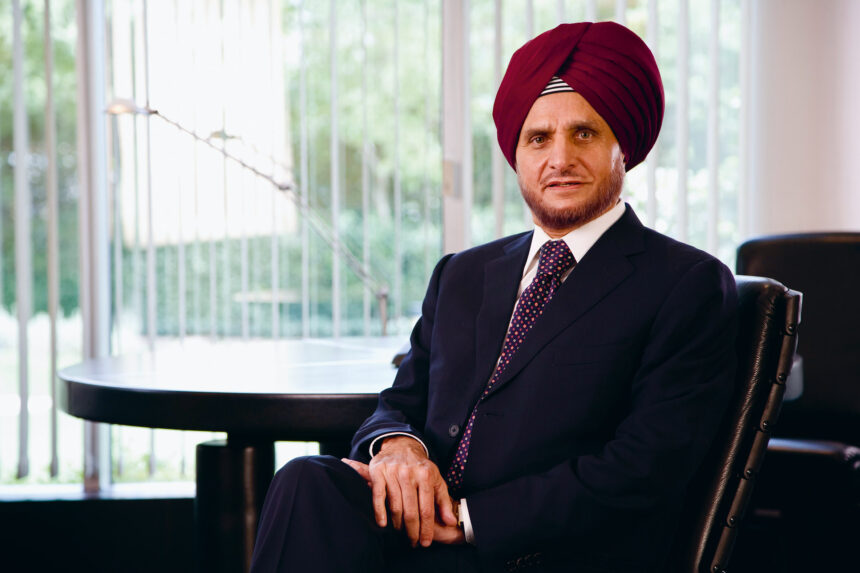
Emerging market corporate leaders are showcasing impressive expansion, mirroring the BRICS group’s rise to rival the G7 in economic weight. This momentum supports a unified BRICS economic agenda, as highlighted in an exclusive interview with BRICS Business Magazine by Onkar Kanwar, Chairman of Apollo Tyres Ltd and head of the Indian segment of the BRICS Business Council.
Corporate Champions in Emerging Markets
According to a recent BCG report, from 2004 to 2014, revenues of the top 100 multinational corporations from developing countries grew three times faster than those from developed nations. Despite political risks and a sluggish global economy, these leaders from emerging markets are rapidly expanding both domestically and internationally. What are your thoughts on these findings, and what drives their success?
Yes, multinational players from emerging markets are performing strongly. The primary reason for any organization’s success lies in its leadership and strategic decisions regarding operations, human resource management, marketing, research, and global expansion. Therefore, it would be unfair to categorize successful companies solely by geography.
Nevertheless, there’s no doubt that multinationals from developing countries are invading new territories and growing faster than traditional competitors. This can be attributed to advantages like low production costs, access to talented local workforce, and cost-effective research capabilities. With large consumer bases, these countries also provide attractive markets for their own multinationals.

For more on Asia-Pacific growth, [Link to related BRICS article].
China’s Lead in Innovation
China leads other developing countries significantly: BCG’s list features 28 Chinese companies compared to just 16 from India. What gives Chinese firms such a remarkable competitive edge? Do Indian corporate leaders have enough potential for equally rapid overseas expansion?
Chinese companies, equipped with advanced and affordable technologies, hold advantages over competitors from both developing and Western countries. They have built expertise across diverse sectors, including aviation, telecommunications, and industrial goods.
Regarding Indian companies’ potential, they are certainly capable of expanding abroad. With strong positions, Indian firms have enormous potential for exponential growth. India is catching up to China. In fact, in terms of growth rates, we are already ahead. Indian companies hold a solid share in the global pharmaceutical market. Even IT firms have entered key strategic deals and partnerships, growing quickly overseas. These are signs that India is not lagging far behind.
Many Indian companies are well-established and possess sufficient resources for entering foreign markets. Additionally, India has successfully navigated the downturn affecting emerging markets, further proving that local companies are in a strong position for expansion.

According to OECD data on China innovation [https://www.oecd.org/innovation/], this edge is evident.
India’s Economic Reforms Under Modi
It’s almost a common narrative that India is desperately trying to catch up and surpass China in the battle for Asian leadership and beyond. What do you think of Indian Prime Minister Narendra Modi’s economic policies?
I certainly welcome them, and the progress is substantial. Look: In 2015–2016, India’s economy grew by 7.6% and is now among the fastest-growing major economies worldwide. Moreover, growth is expected to accelerate despite global challenges.

India is ranked among the most attractive destinations for foreign investors. Traditional advantages like demographics and a large consumer market are complemented by a stable focus on strategic reforms and initiatives to improve ease of doing business. For instance, rules on foreign direct investment have been relaxed in many sectors, including defense, railways, food retail, insurance, and more. Truthfully, the net foreign direct investment inflows in the 2015 and 2016 financial years exceeded the 2014 figure by over 50%. Thanks to recent changes in FDI regulations, India stands out as the world’s most open economy.
Indian authorities are very open to new ideas and proposals that can help modernize, progress, and develop the economy. Of course, much work remains, and further reforms are needed, particularly in labor, as well as land-related laws and regulations. Steps in this direction have been initiated, and I am confident they will materialize soon.
Riding the Trend: Apollo Tyres’ Position
Speaking of the BCG trend, where does Apollo Tyres stand on it? How did your business fare on the home market and abroad during that period?
Apollo Tyres has two home markets: India and Europe (with manufacturing facilities on both continents). In both, we continued to grow and increase market share. We are currently investing in further growth in India, where we are doubling the capacity of our largest plant, and in Hungary, where we are building a new global-scale facility.
Brexit’s Impact on Europe
What does Brexit mean for Europe’s economy? Have your plans for further production buildup in the EU changed?
It’s too early to judge the manifestations and scale of Brexit in the context of the European economy. Our investment plans in Hungary remain unchanged.
African Business Progress
How is your African business advancing?
Over the last decade, Africa has been called a strengthening economic force, but now it seems to be losing momentum. It still has enormous potential in various sectors. We have seen governments launch initiatives to unlock it and offer citizens progress in development and growth. Apollo continues to seek suitable opportunities in relevant markets, and we invest as needed.
For insights on African investments, refer to IMF reports [https://www.imf.org/en/Countries/Regions/Africa].
Agenda for BRICS
BRICS is still seen more as a political club and to a lesser extent as a group promoting a joint economic agenda. What do you think of this bloc as an economic entity, and which economic directions deserve priority development?
In 2015, the combined GDP of these five countries at purchasing power parity reached $30.8 trillion, while the G7’s was $35.6 trillion. Moreover, BRICS contributed about 45% to global economic growth in the last decade. So, BRICS is undoubtedly a force to be reckoned with in the global system. Plus, it includes five major economies from continents like Africa, Eurasia, and South America.
Furthermore, all BRICS countries are committed to advancing a joint economic agenda. The main message of BRICS in 2016 – creating adaptive, inclusive, and collective solutions – clearly underscores this desire to strengthen economic interaction.
A key event within BRICS is the establishment of the New Development Bank (NDB), designed to serve as a funding source for developing economies to meet their development needs.
The alliance has a grand plan outlined in the form of the BRICS economic partnership strategy. Priority areas of cooperation include trade and investment, manufacturing, energy, agriculture, science and technology, innovation, ICT, finance, as well as physical, institutional, and human connectivity. So, we are definitely progressing in building our strategic partnership in a clearly defined manner.
In conclusion, the BRICS economic agenda fosters resilience, with focuses on Asia-Pacific growth, China innovation, and African investments paving the way for sustained success.